
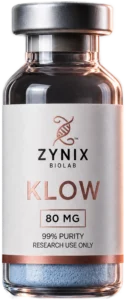
Blend Composition + Dosage Chart
Blend Composition
The 80 mg vial contains four peptide components at fixed proportions, sourced explicitly by the vial dosage protocol. [11]
| Component | Amount in vial | Concentration once reconstituted |
|---|---|---|
| TB-500 | 10 mg | ~3.33 mg/mL |
| BPC-157 | 10 mg | ~3.33 mg/mL |
| KPV | 10 mg | ~3.33 mg/mL |
| GHK-Cu | 50 mg | ~16.7 mg/mL |
| Total | 80 mg | ~26.7 mg/mL |
Dosage Chart
Once-daily subcutaneous injection using a U-100 insulin syringe; all four components are drawn together in a single shot from the reconstituted vial, escalating over four weeks to a maintenance phase. [11]
| Week(s) | TB-500 | BPC-157 | KPV | GHK-Cu | Syringe units | Volume |
|---|---|---|---|---|---|---|
| 1–2 | 250 mcg | 250 mcg | 250 mcg | 1.25 mg | 7.5 u | 0.075 mL |
| 3–4 | 500 mcg | 500 mcg | 500 mcg | 2.5 mg | 15 u | 0.15 mL |
| 5–8 | 750 mcg | 750 mcg | 750 mcg | 3.75 mg | 22.5 u | 0.225 mL |
| 9–12 (maintenance) | 500 mcg | 500 mcg | 500 mcg | 2.5 mg | 15 u | 0.15 mL |
These figures check out arithmetically against the vial composition above: each component's dose divided by its own concentration lands on the same draw volume within each phase, confirming a single consistent shot delivers all four components at once. The primary cycle runs 8–12 weeks, with an optional extension to 16 weeks; the source reviewed for this page does not explicitly state a recovery or off period for this specific blend. [11]
Reconstitution
80 mg vial, mixed to a working concentration before drawing a dose.
Add 3.0 mL of bacteriostatic water to the 80 mg vial to yield a total concentration of approximately 26.7 mg/mL. [11]
Before reconstitution, store the lyophilized vial at −20 °C or below in dry conditions. Once reconstituted, store at 2–8 °C and avoid repeated freeze-thaw cycles; use within 14–28 days. [11]
How It Works
The literature below is component literature: studies of the four individual peptides in KLOW, not of the blend itself. No published study has tested this specific four-component combination in humans.
GHK-Cu stimulates collagen, elastin, and glycosaminoglycan synthesis, modulates metalloproteinases and their inhibitors, and promotes blood vessel and nerve outgrowth; it plays a physiological role in wound healing through fibroblast collagen production during tissue remodeling. [1][2][3]
BPC-157 is a pentadecapeptide isolated from human gastric juice, described in the literature as an anti-inflammatory agent supporting tissue repair in gastrointestinal, musculoskeletal, and wound contexts. See the full BPC-157 protocol page on this site for its detailed mechanism, pharmacokinetics, and citations.
TB-500 is a synthetic peptide derived from the active region of thymosin beta-4 (the peptide segment LKKTETQ), supporting actin-related cell migration, wound healing, and tendon repair. [5] In a rat model of Achilles tendon injury (32 rats in four groups, dosed intraperitoneally for four weeks), TB-500 alone showed the clearest histopathological and biomechanical result; the study's own results state that "Combined BPC-157 and TB-500 treatment did not confer additional benefits compared to either agent alone." [4]
KPV is a tripeptide representing the minimal active C-terminal sequence of alpha-melanocyte-stimulating hormone (alpha-MSH), with potent anti-inflammatory effects reported via melanocortin-3 receptor (MC3R) agonism. [6] KPV has demonstrated anti-inflammatory potential in murine models of inflammatory bowel disease, [7] and a nanoparticle-based oral delivery formulation of KPV was reported to combine accelerated mucosal healing with reduced inflammation in ulcerative colitis models. [8] A separate study investigated KPV's mechanism through MC3R agonist pathways in human bronchial epithelial cells, in the context of airway inflammation. [9]
No human safety or efficacy data exists for KLOW as a blended product. Individual component data come from in vitro, animal, and limited human pilot studies for each peptide separately; the safety, efficacy, and any pharmacokinetic interaction of this specific four-component combination and titration schedule have not been studied in humans. KLOW, as a named product, is not FDA-approved, has no registration in Drugs@FDA, and has no established prescribing label; its individual components similarly lack FDA approval for any indication. [10] This section describes what the component literature reports; it is not a claim of safety or effectiveness for this blend in human use.
References
Component literature. None of these studies tested the KLOW blend itself.
[1] Regenerative and Protective Actions of the GHK-Cu Peptide · Pickart & Margolina, 2018, PMID 29986520
[2] GHK as a Cellular Pathway Modulator · 2015, PMID 26236730
[3] The Human Tri-Peptide GHK and Tissue Remodeling · 2008, PMID 18644225
[4] Effects of BPC-157 and TB-500 on Achilles Tendon Healing in Rats · 2026, PMID 42542926
[5] Doping Control Analysis of TB-500 · 2012, PMID 23084823
[6] Alpha-Melanocyte-Stimulating Hormone and Related Tripeptides · Delgado & Ganea, 2008, PMID 18612139
[7] Melanocortin-Derived Tripeptide KPV Has Anti-Inflammatory Potential in Murine Models of Inflammatory Bowel Disease · 2008, PMID 18092346
[8] Orally Targeted Delivery of Tripeptide KPV via Hyaluronic Acid-Functionalized Nanoparticles · 2017, PMID 28143741
[9] Inhibition of Cellular and Systemic Inflammation Cues in Human Bronchial Epithelial Cells · 2012, PMID 22837805
[10] KLOW overview · PeptideDosages
[11] KLOW 80 mg vial dosage protocol · PeptideDosages