
Dosage Chart
Gradual titration schedule for the 10 mg vial, administered once daily by subcutaneous injection. [7]
| Phase | Daily dose | Units (U-100) | Volume |
|---|---|---|---|
| Weeks 1–2 | 200 mcg | 6 u | 0.06 mL |
| Weeks 3–4 | 400 mcg | 12 u | 0.12 mL |
| Weeks 5–8+ | 600 mcg | 18 u | 0.18 mL |
Reported protocols typically run 8–12 weeks, with an optional extension to 16 weeks depending on the research objective. [7] The titration schedule above reflects the source protocol for the 10 mg vial.
Reconstitution
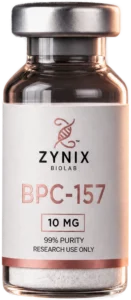
10 mg vial, mixed to a working concentration before drawing a dose.
Add 3.0 mL of bacteriostatic water to the 10 mg vial, yielding a concentration of 3.33 mg/mL. [7] Inject the water slowly along the vial wall to avoid foam formation, then gently swirl (do not shake) until fully dissolved. [7]
Store the reconstituted solution at 2–8 °C, in a dark environment, and avoid repeated freeze-thaw cycles. Let the vial warm to room temperature before opening to reduce condensation. [7] The sources reviewed for this page do not state a specific shelf life for the reconstituted solution: treat any fixed "use within X days" figure as unverified until it is sourced, and see the full reconstitution guide for handling detail.
How It Works
BPC-157 is a pentadecapeptide isolated from human gastric juice. [2] In animal models the peptide clears from plasma in under 30 minutes, [1] yet the biological effects described in those studies persist far longer. Why that gap exists is still an open question in the formulation literature. [5] Following intramuscular injection, mean absolute bioavailability was approximately 14–19% in rats and 45–51% in beagle dogs. [1]
The compound remains investigational, with limited and preliminary human clinical data. [7] Published human evidence is restricted to small uncontrolled pilot studies such as the intravenous safety pilot in two healthy adults, which found no measurable changes in cardiac, hepatic, renal, or thyroid biomarkers at doses up to 20 mg, [3] and the ulcerative colitis trial (PL-14736), which reported efficacy signals with no toxicity, though its full results have not been independently published as a standalone peer-reviewed paper. [4]
BPC-157 is not approved by the FDA for any indication, and there is no standard approved dosage framework. It is also listed under the World Anti-Doping Agency's S0 category of unapproved substances and is prohibited in athletic competition. [6] Formulation and regulatory barriers to translational development remain active areas of review. [5] This section describes what the cited literature reports; it is not a claim of safety or effectiveness for human use.
References
[1] Frontiers in Pharmacology (2022) · Pharmacokinetics, distribution, metabolism, and excretion of BPC-157 in rats and dogs
[2] MDPI Pharmaceuticals (2025) · Multifunctionality and possible medical application of the BPC-157 peptide, literature and patent review
[3] Safety of Intravenous Infusion of BPC157 in Humans · A pilot study, PMID 40131143
[4] Ulcerative colitis Phase II trial, PL-14736 · PMID 22300085 (referenced in secondary sources)
[5] BPC-157 as an Investigational Peptide Therapeutic · Biopharmaceutical challenges, formulation strategies, and translational development barriers, PMID 42198317
[6] BPC-157 overview · PeptideDosages
[7] BPC-157 10 mg vial dosage protocol · PeptideDosages