
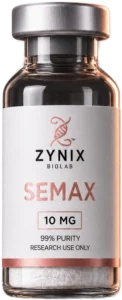
Dosage Chart
Intranasal drops or a measured intranasal spray solution are the route discussed in the human literature for Semax; this is not a subcutaneous injection protocol. [3]
| Dilution option | Concentration | Per spray (0.10 mL) |
|---|---|---|
| 5 mL final volume | 2,000 mcg/mL | 200 mcg |
| 10 mL final volume | 1,000 mcg/mL | 100 mcg |
Published research doses vary by study population, formulation, and objective, and no standardized clinical dosing has been established for general research use. [4]
Reconstitution
10 mg vial, two dilution options depending on target concentration.
Two reconstitution targets are described for the 10 mg vial: a 5 mL final volume yielding 2,000 mcg/mL, and a 10 mL final volume yielding 1,000 mcg/mL. [4]
Store the registered formulation protected from light, at no more than 10 °C, and do not freeze. Once opened, storage at no more than 25 °C is described as permitted for up to 15 days. [4] The sources reviewed for this page do not specify a shelf life for custom reconstituted preparations beyond that: treat any fixed "use within X days" figure for a custom preparation as unverified until it is sourced, and see the full reconstitution guide for handling detail.
How It Works
Semax is a synthetic heptapeptide related to the ACTH 4-7 fragment with a Pro-Gly-Pro extension and the amino acid sequence Met-Glu-His-Phe-Pro-Gly-Pro. [3] It is identified as a neuroprotective agent targeting neuroplasticity pathways; in an animal model of Alzheimer's disease, both Semax and a derivative improved cognitive function in mice and reduced the number of amyloid inclusions in the cortex and hippocampus. [1] A 2026 review of therapeutic peptides in gerontology identifies Semax as a neuroprotective agent, while noting that non-approved peptides generally lack long-term safety data and systematic validation. [2]
Human clinical evidence is limited and comes primarily from Russian and Eastern European research centers, as described on the source page reviewed for this protocol. A 1997 study looked at acute ischemic stroke, with 30 Semax-treated patients versus 80 controls. A 2018 neuroimaging study examined default-mode network changes in 14 Semax subjects versus 10 placebo controls, and a separate 2018 stroke-rehabilitation study reported higher plasma BDNF with early rehabilitation plus Semax. [3] None of these three human studies carries an independently verifiable PMID in the sources reviewed for this page; they are described here as reported on that source page, not as independently confirmed peer-reviewed findings.
Semax is not approved by the FDA for any indication in humans, and the FDA has identified compounded Semax drugs as presenting immunogenicity and impurity concerns. [3] This section describes what the cited literature reports; it is not a claim of safety or effectiveness for human use.
References
[1] The Potential of the Peptide Drug Semax and Its Derivative for Correcting Pathological Impairments in an Animal Model of Alzheimer's Disease · PMID 41479572
[2] Therapeutic Peptides in Gerontology: Mechanisms and Applications for Healthy Aging · PMID 42021992
[3] Semax overview · PeptideDosages
[4] Semax 10 mg vial dosage protocol · PeptideDosages