
Dosage Chart
| Context | Dose | Units (U-100) equiv. | Volume equiv. |
|---|---|---|---|
| FDA-approved (Vyleesi) | 1.75 mg, as-needed | ≈53 u | ≈0.53 mL |
| Investigational, Weeks 1–8 | 500 mcg (0.5 mg) | 15 u | 0.15 mL |
| Investigational, Weeks 9–12 | 1,000 mcg (1.0 mg) | 30 u | 0.30 mL |
| Investigational, Weeks 13–16 | 1,500 mcg (1.5 mg) | 45 u | 0.45 mL |
Approved use: no more than one dose within 24 hours, and no more than eight doses per month, administered at least 45 minutes before anticipated sexual activity. [4] Investigational use: once-daily subcutaneous injection (abdomen or thigh); reported protocols run 8–12 weeks, with an optional extension to 16 weeks. [5]
Reconstitution
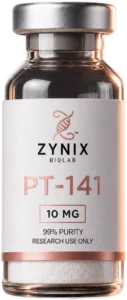
10 mg research vial, mixed to a working concentration before drawing a dose. This step applies to the investigational protocol; the FDA-approved Vyleesi autoinjector arrives pre-dosed and is not reconstituted by the patient.
Add 3.0 mL of bacteriostatic water to the 10 mg vial to yield a final concentration of approximately 3.33 mg/mL. [5]
Before reconstitution, freeze the lyophilized vial at −20 °C. Once reconstituted, refrigerate at 2–8 °C. [5] Use the reconstituted solution within approximately 30 days, and avoid repeated freeze-thaw cycles. [5]
How It Works
PT-141, known as bremelanotide, is a synthetic peptide and melanocortin receptor agonist developed for sexual desire dysfunction. [4] It activates melanocortin-4 receptors in the hypothalamus to increase sexual desire and arousal; in the FDA-approved indication, effect is reported at least 45 minutes after subcutaneous injection. [4]
In premenopausal women with HSDD, bremelanotide improved desire and distress endpoints compared with placebo in the trials supporting its approval, with common side effects including nausea, flushing, headache, and injection-site reactions. [4] A 2026 review of pharmacological therapies for HSDD describes flibanserin and bremelanotide as the most extensively studied agents for the condition, while noting that endpoint designation and reporting completeness varied across the trials it examined. [1] A separate 2026 paper on macrocyclic peptide design cites bremelanotide as an example of the recent clinical success of macrocyclic peptides in balancing the properties of small molecules and biologics. [2] A stability study of bremelanotide acetate reported lower degradation under acidic conditions than under basic conditions, with susceptibility to oxidative stress. [3]
PT-141 is FDA-approved only under the brand name Vyleesi, for acquired, generalized HSDD in premenopausal women, at a fixed 1.75 mg dose with a maximum of eight doses per month. [4] Uses outside this indication and dose, including the investigational titration schedule on this page, are off-label. This section describes what the cited literature reports; it is not a claim of safety or effectiveness for off-label use.
References
[1] Clinical Trial Evidence on Emerging Pharmacological Therapies for HSDD in Women · PMID 42254382
[2] Goldilocks-Inspired Design of Mid-Size Macrocycles for Selective Targeting of Human Melanocortin Receptors · PMID 42340853
[3] Comprehensive Characterization of Bremelanotide Acetate and Its Degradants · PMID 42485063
[4] PT-141 overview · PeptideDosages
[5] PT-141 10 mg vial dosage protocol · PeptideDosages