
Dosage Chart
Fixed dose, no titration: 5,000 mcg (5 mg) once daily for 20 consecutive days, preferably in the evening or at bedtime to align with natural melatonin rhythms. [5]
| Protocol | Daily dose | Units (U-100) | Volume |
|---|---|---|---|
| Days 1–20 | 5,000 mcg (5 mg) | 100 u | 1.00 mL |
A 1.00 mL dose is the full volume of a standard 1 mL/100-unit syringe. Each 10 mg vial reconstituted this way yields approximately 2 doses at the standard 5 mg daily protocol, so a full 20-day cycle draws from about 10 vials. [5] Animal research (mice) used approximately 1.0 microgram per mouse, roughly 30–40 micrograms per kilogram; this rodent dosing is not a basis for the human protocol above and is included only as background. [1]
Reconstitution
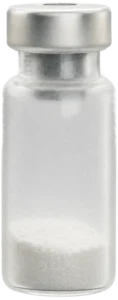
10 mg vial, mixed to a working concentration before drawing a dose.
Add 2.0 mL of bacteriostatic water to the 10 mg vial to yield a final concentration of 5.0 mg/mL. [5]
Freeze the lyophilized vial at −20 °C in dry conditions before reconstitution. Once reconstituted, refrigerate at 2–8 °C and use within 2–4 weeks; avoid repeated freeze-thaw cycles. [5]
How It Works
Epithalon (also called Epitalon) is a synthetic tetrapeptide with the amino acid sequence Ala-Glu-Asp-Gly (AEDG) and molecular formula C14H22N4O9. It is a synthetic pineal tetrapeptide studied for proposed effects on telomere biology, telomerase activity, melatonin rhythm, and age-related mechanisms. [4]
A 2025 review reports that the peptide exerts a direct influence on melatonin synthesis, alters interleukin-2 mRNA levels, and enhances the activity of several enzymes, including telomerase. [1] In an in vitro mouse-oocyte model, epitalon at 0.1 mM concentration reduced intracellular reactive oxygen species, increased mitochondrial membrane potential and mitochondrial DNA copy number, and decreased apoptosis; this is a cell-model finding, not a human clinical result. [2] In a 2024 human biomarker study in elderly subjects, AEDG peptide application was associated with regulation of circadian-rhythm genes (Cry2, AANAT, ASMT, CLOCK) in buccal epithelium, alongside reduced expression of apoptosis-promoting proteins. [3]
Human evidence overall is limited and regionally concentrated, not strong enough to establish Epithalon as a general longevity or sleep treatment; preclinical evidence in cell and animal models is stronger than the clinical evidence. [4] Epithalon is not FDA-approved for general therapeutic, longevity, or sleep use. FDA records show an orphan-drug designation was filed for retinitis pigmentosa, but that indication's status is explicitly "Not FDA Approved for Orphan Indication," meaning the designation exists without the approval that would follow it. [4] The FDA has separately identified safety concerns for compounded Epithalon, including possible immunogenicity from aggregation and peptide-related impurities. [4] A sleep/insomnia application was scheduled for FDA discussion in July 2026 but remains unapproved. [4] This section describes what the cited literature reports; it is not a claim of safety or effectiveness for human use.
References
[1] Overview of Epitalon: Highly Bioactive Pineal Tetrapeptide With Promising Properties · 2025, PMID 40141333
[2] Epitalon Protects Against Post-Ovulatory Aging-Related Damage of Mouse Oocytes In Vitro · 2022, PMID 35413689
[3] Peptidergic Regulation of Expression of Cellular Aging Marker Proteins in Buccal Epithelium · 2024, PMID 39742404
[4] Epithalon overview · PeptideDosages
[5] Epithalon 10 mg vial dosage protocol · PeptideDosages