
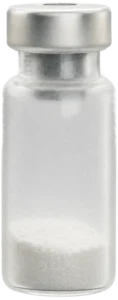
Dosage Chart
Once-weekly subcutaneous injection for the 10 mg vial, doubling the dose roughly every 2 weeks as tolerated. [4]
| Phase | Weekly dose | Units (U-100) | Volume |
|---|---|---|---|
| Weeks 1–2 | 0.6 mg | 18 u | 0.18 mL |
| Weeks 3–4 | 1.2 mg | 36 u | 0.36 mL |
| Weeks 5–6 | 2.4 mg | 72 u | 0.72 mL |
| Weeks 7–16 (maintenance) | 4.5 mg | 135 u | 1.35 mL |
The 4.5 mg maintenance dose (135 units, 1.35 mL) exceeds the marked capacity of a standard 1 mL/100-unit syringe and needs a larger syringe or a split dose. Protocols run 8–16 weeks, reaching the maintenance dose by weeks 7–8. [4] Phase 2 monotherapy trials separately tested 0.3, 0.6, 1.2, 2.4, and 4.5 mg once-weekly doses. [3]
Reconstitution
10 mg vial, mixed to a working concentration before drawing a dose.
Add 3.0 mL of bacteriostatic water to the 10 mg vial to yield a concentration of approximately 3.33 mg/mL; at this concentration, 1 unit on a U-100 insulin syringe is approximately 33.3 mcg. [4] Inject the water slowly down the vial wall, avoiding foaming or vigorous agitation; gently swirl or roll until fully dissolved. [4]
Store the lyophilized vial at −20 °C in dry, dark conditions. Once reconstituted, refrigerate at 2–8 °C and use within 30 days; avoid repeated freeze-thaw cycles. [4]
How It Works
Cagrilintide is a long-acting, lipidated amylin analog with activity at calcitonin-family receptors, derived from the biology of amylin, a hormone involved in satiety and glucose regulation. [3]
In a systematic review and GRADE-assessed meta-analysis, CagriSema produced significantly greater weight loss than semaglutide alone (mean difference of −7.58 kg) and demonstrated superior efficacy to both component monotherapies. [1] A separate review of amylin-based pharmacotherapy proposed that long-acting amylin agents, including cagrilintide, may dissociate weight-loss benefits from gastrointestinal side effects through receptor pharmacology and neural mechanisms distinct from GLP-1 monotherapy. [2]
Gastrointestinal adverse events occurred in 72.5%–79.6% of participants receiving CagriSema in Phase 3 trials, with nausea and vomiting as the primary safety concerns. [3] Cagrilintide remains investigational, with no FDA-approved dosage outside clinical trial contexts. [3] This section describes what the cited literature reports; it is not a claim of safety or effectiveness for human use.
References
[1] Maximizing Weight Loss With CagriSema · Systematic review and meta-analysis, PMID 42608559
[2] Beyond GLP-1: Amylin-Based Pharmacotherapy and the Search for Better-Tolerated Weight-Loss Drugs · PMID 42586227
[3] Cagrilintide overview · PeptideDosages
[4] Cagrilintide 10 mg vial dosage protocol · PeptideDosages