
Dosage Chart
Once-weekly subcutaneous injection, on the same day each week. [5] The dossier used for this page describes a single dosing schedule, framed as the approved range; no separate off-label or investigational schedule is given in the source reviewed here.
| Phase | Weekly dose | Units (U-100) | Volume |
|---|---|---|---|
| Weeks 1–4 (initiation) | 2.5 mg | 25 u | 0.25 mL |
| Weeks 5–8 | 5.0 mg | 50 u | 0.50 mL |
| Weeks 9–12 | 7.5 mg | 75 u | 0.75 mL |
| Weeks 13–16+ (maintenance) | 10.0 mg | 100 u | 1.00 mL |
The 10.0 mg/100-unit dose fills the entire volume of a standard 1 mL/100-unit syringe. This titration escalates over 16 weeks. [5]
Reconstitution
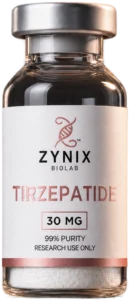
30 mg vial, mixed to a working concentration before drawing a dose.
Add 3.0 mL of bacteriostatic water to the 30 mg vial to yield a final concentration of 10.0 mg/mL. At this concentration, 1 unit on a U-100 insulin syringe equals 0.01 mL, or 100 mcg of tirzepatide. [5]
Store the lyophilized vial at −20 °C in dry, dark conditions. Once reconstituted, refrigerate at 2–8 °C and do not freeze; use within 28 days. [5]
How It Works
Tirzepatide is a synthetic peptide engineered to activate two incretin receptors, the glucose-dependent insulinotropic polypeptide (GIP) receptor and the glucagon-like peptide-1 (GLP-1) receptor, with a pharmacokinetic profile designed for once-weekly administration. [4]
In head-to-head SURPASS trials, tirzepatide showed greater reductions in A1C and body weight compared with semaglutide 1 mg. [4] A related analysis found that after tirzepatide treatment, approximately 60% of adults with type 2 diabetes shifted to a lower, improved BMI category, with documented cardiometabolic improvements. [1] In SURMOUNT-1, once-weekly tirzepatide produced substantial mean body weight reductions in adults with obesity or overweight; [4] a post hoc analysis of the SURMOUNT trials found that tirzepatide achieved combined thresholds of body-weight reduction, systolic blood pressure reduction of at least 5 mmHg, and non-HDL cholesterol below 130 mg/dL in people with obesity, with or without type 2 diabetes. [2] A separate literature review examined whether tirzepatide, used as an anti-diabetic agent, could affect cancer risk in patients with diabetes and cancer, without reaching a settled conclusion either way. [3]
Gastrointestinal effects, nausea, diarrhea, vomiting, and constipation, are the most frequently reported adverse effects. [4] Tirzepatide is FDA-approved under the brand names Mounjaro (type 2 diabetes) and Zepbound (chronic weight management; moderate-to-severe obstructive sleep apnea in adults with obesity). [4] This section describes what the cited literature reports; it is not a claim of safety or effectiveness beyond the approved indications.
References
[1] Improvement in BMI Category Associated With Cardiometabolic Measures in Type 2 Diabetes Treated With Tirzepatide · PMID 40707399
[2] Achieving the Triple Endpoint With Tirzepatide in People With Obesity · SURMOUNT post hoc analysis, PMID 42594122
[3] Tirzepatide, Friend or Foe in Diabetic Cancer Patients? · PMID 36358930
[4] Tirzepatide overview · PeptideDosages
[5] Tirzepatide 30 mg vial dosage protocol · PeptideDosages