
Dosage Chart
| Context | Daily dose | Units (U-100) | Volume |
|---|---|---|---|
| FDA-approved (EGRIFTA SV) | 1.4 mg | 42 u | 0.42 mL |
| Investigational, Week 1 | 1 mg (1,000 mcg) | 30 u | 0.30 mL |
| Investigational, Weeks 2+ | 2 mg (2,000 mcg) | 60 u | 0.60 mL |
The labeled EGRIFTA SV dose is administered once daily subcutaneously for the approved indication. [4] The investigational schedule uses 1 mg for tolerability in week 1, then 2 mg once daily from week 2 onward, which is higher than the approved label. [5] A 60-unit dose exceeds the marked capacity of a standard 0.3 mL/30-unit syringe; a 1 mL/100-unit syringe is needed at that dose.
Reconstitution
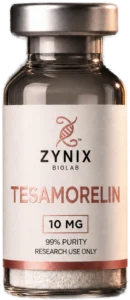
10 mg vial, mixed to a working concentration before drawing a dose.
Add 3.0 mL of bacteriostatic water to the 10 mg vial, yielding a concentration of approximately 3.33 mg/mL. [5] Inject the water slowly down the vial wall, then gently swirl until dissolved without shaking; vigorous shaking may denature the peptide. [5]
Before reconstitution, refrigerate the lyophilized form at 2–8 °C. Once reconstituted, do not freeze and avoid repeated freeze-thaw cycles; store at 2–8 °C. [5] Use the reconstituted solution within 7 days. [5]
How It Works
Tesamorelin is a synthetic peptide analog of growth hormone-releasing hormone (GHRH, also called growth hormone-releasing factor). It functions as a GHRH receptor agonist at the pituitary gland, stimulating endogenous growth hormone release rather than providing direct hormone replacement. [4][3]
A systematic review and meta-analysis reported that tesamorelin 2 mg significantly reduced visceral adipose tissue and increased lean body mass in HIV patients on antiretroviral therapy, though discontinuation rates were higher in treatment groups than in controls. [1] A separate pilot study of low-dose tesamorelin (1 mg) found no direct significant changes in cognitive or physical measures, though machine learning analysis suggested potential treatment-related differences in brain regions associated with cognitive function. [2] Reductions in visceral fat have been reported not to persist after discontinuation, suggesting the effects are treatment-dependent. [4]
Tesamorelin is FDA-approved under the brand name EGRIFTA SV for a specific indication: reduction of excess abdominal fat in HIV-infected adult patients with lipodystrophy. Approval is limited to this population and does not extend to general weight loss, anti-aging, or athletic performance uses; those uses are off-label. [4] Compounded versions lack the FDA premarket review and quality assurance of the approved EGRIFTA SV product. [4] This section describes what the cited literature reports; it is not a claim of safety or effectiveness for off-label use.
References
[1] Efficacy and Safety of Tesamorelin in People Living With HIV With Lipodystrophy · Systematic review and meta-analysis, PMID 42538058
[2] The Effect of Growth Hormone-Releasing Hormone on Cognition and Brain Connectivity · PMID 42382101
[3] Tesamorelin and GHRH Agonists: Mechanism of Action and Clinical Applications · Review, PMID 42395176
[4] Tesamorelin overview · PeptideDosages
[5] Tesamorelin 10 mg vial dosage protocol · PeptideDosages