
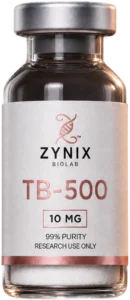
Dosage Chart
Gradual titration schedule for the 10 mg vial over 12 weeks, administered once daily by subcutaneous injection. Rotate injection sites (abdomen, thighs, upper arms) systematically. [5]
| Phase | Daily dose | Units (U-100) | Volume |
|---|---|---|---|
| Weeks 1–2 | 500 mcg | 15 u | 0.15 mL |
| Weeks 3–4 | 600 mcg | 18 u | 0.18 mL |
| Weeks 5–8 | 750 mcg | 23 u | 0.23 mL |
| Weeks 9–12 | 1 mg (1,000 mcg) | 30 u | 0.30 mL |
Units are rounded to the nearest whole mark on a standard U-100 insulin syringe at the 3.33 mg/mL working concentration. The 750 mcg phase rounds to 23 u from a calculated 22.5 u.
Reconstitution
10 mg vial, mixed to a working concentration before drawing a dose.
Add 3.0 mL of bacteriostatic water to the 10 mg vial, yielding a concentration of 3.33 mg/mL. [5] Inject the water slowly along the vial wall to avoid foam formation, then gently swirl (do not shake vigorously) until fully dissolved. [5]
Before reconstitution, store the lyophilized peptide at −20 °C in dry, dark conditions. Once reconstituted, refrigerate at 2–8 °C and do not freeze; avoid repeated freeze-thaw cycles and let the vial warm to room temperature before opening to reduce condensation. [5] Reconstituted vials remain stable for up to 28 days when stored with bacteriostatic water preservative at proper refrigeration temperature. [5]
How It Works
TB-500 is a synthetic peptide related to thymosin beta-4, a naturally occurring protein involved in actin regulation, cell movement, and tissue-repair biology. It is structurally derived from the naturally occurring 43-amino-acid thymosin beta-4 but differs in composition. [4]
In a rat model of Achilles tendon injury (32 rats in four groups, dosed intraperitoneally for four weeks), TB-500 alone showed the clearest result, with significantly lower Bonar and Movin histopathology scores and a significant biomechanical advantage over controls; the study's own results state that "Combined BPC-157 and TB-500 treatment did not confer additional benefits compared to either agent alone." [3] Independently documented human clinical trial data for TB-500 could not be verified in the sources reviewed for this page. Review literature describes TB-500 as showing "promising but variable effects" in animal models for tissue healing, while noting that human clinical studies were limited, with only modest improvements documented where reported. [2] A separate 2026 review lists TB-500 among regenerative peptides relevant to chronic pain management, while noting that clinical evidence remains limited. [1]
TB-500 is not approved by the FDA for any indication. No FDA-approved TB-500 product exists, there is no approved-label dosage, and it has no entry in Drugs@FDA databases with therapeutic indications or prescribing information. The World Anti-Doping Agency lists thymosin beta-4 and its derivatives, including TB-500, as prohibited substances in sport. [4] This section describes what the cited literature reports; it is not a claim of safety or effectiveness for human use.
References
[1] Peptides in Regenerative Medicine · A comprehensive review of clinical applications in tissue repair and chronic pain management, PMID 42635865
[2] Peptide Supplements and Their Therapeutic Applications in Sports Medicine · PMID 42578445
[3] Effects of BPC-157 and TB-500 on Achilles Tendon Healing in Rats · PMID 42542926
[4] TB-500 overview · PeptideDosages
[5] TB-500 10 mg vial dosage protocol · PeptideDosages