
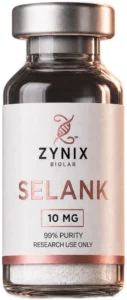
Dosage Chart
Intranasal administration is described as the primary route for CNS delivery of Selank; this is not a subcutaneous injection protocol. [2] Published human studies used fixed dosing, not a progressive titration schedule. [3]
| Reported dose | Frequency / route | Source study |
|---|---|---|
| 2.7 mg | Per day, intranasal | Zozulia et al. |
| 2,700 mcg | Per day, intranasal | Syunyakov et al. |
| 0.2 mg | Single exposure, total amount | Panikratova et al. |
These figures come from three different published human studies with varying designs, cited on the vial dosage protocol source page; they are not a single unified daily protocol. [3] Human clinical doses are not standardized in FDA-approved labeling. [2]
Reconstitution
10 mg vial, two dilution options depending on target concentration.
Add 3.0 mL of compatible sterile vehicle to the vial, then approximately 2.0 mL additional vehicle for a 5 mL final volume, yielding 2,000 mcg/mL; or approximately 7.0 mL additional vehicle for a 10 mL final volume, yielding 1,000 mcg/mL. [3]
Store the registered formulation protected from light, at no more than 10 °C, and do not freeze. Once opened, storage at no more than 25 °C is described as permitted for up to 15 days. [3] The sources reviewed for this page do not specify a shelf life for custom reconstituted preparations, and guidance instead points to formulation-specific stability and microbiological controls rather than transferring a finished-product shelf life: treat any fixed "use within X days" figure for a custom preparation as unverified until it is sourced, and see the full reconstitution guide for handling detail. [3]
How It Works
Selank is a synthetic heptapeptide with the molecular formula C33H57N11O9 and the amino acid sequence Thr-Lys-Pro-Arg-Pro-Gly-Pro. [2] It is theorized to increase brain-derived neurotrophic factor and HGF/c-Met pathways critical to neuroplasticity. [2] A 2026 paper on neuroactive peptides and neuroplasticity pathways mentions Selank only in passing, as one of several peptides discussed in that context; it is not a Selank-specific study, and its findings should not be read as dedicated evidence for Selank. [1]
Human clinical evidence is limited and comes primarily from Russian research centers, as described on the source page reviewed for this protocol: a 2008 study in 62 patients with generalized anxiety disorder, and a 2014 study in 60 patients with phobic-anxiety disorders, with 40% of participants in the anxiety cohort classified as rapid responders during days 1 to 3. [2][3] Neither the 2008 nor the 2014 study carries an independently verifiable PMID in the sources reviewed for this page; they are described here exactly as reported on that source page, as regional publications whose full peer-reviewed text was not independently verified, not as independently confirmed findings.
Selank does not have an FDA-approved prescribing label and is listed by the FDA as a compounding substance with potential significant safety risks. [2] This section describes what the cited literature reports; it is not a claim of safety or effectiveness for human use.
References
[1] Therapeutic Peptides in Orthopaedics: Applications, Challenges, and Future Directions · J Am Acad Orthop Surg Glob Res Rev, 2026, PMID 41490200 (mentions Selank only in passing; not Selank-specific)
[2] Selank overview · PeptideDosages
[3] Selank 10 mg vial dosage protocol · PeptideDosages