
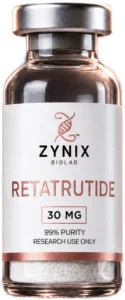
Dosage Chart
Once-weekly subcutaneous injection. Two titration approaches reported in the vial dosage protocol source, plus the target doses used in the Phase 3 TRIUMPH and TRANSCEND trials. [6] Also available: 20 mg vial protocol.
| Standard titration | Weekly dose | Units (U-100) | Volume |
|---|---|---|---|
| Weeks 1–4 | 2 mg | 20 u | 0.20 mL |
| Weeks 5–8 | 4 mg | 40 u | 0.40 mL |
| Weeks 9–12 | 6 mg | 60 u | 0.60 mL |
| Weeks 13+ | 8 mg | 80 u | 0.80 mL |
| Aggressive titration | Weekly dose | Units (U-100) | Volume |
|---|---|---|---|
| Weeks 1–4 | 2 mg | 20 u | 0.20 mL |
| Weeks 5–8 | 4 mg | 40 u | 0.40 mL |
| Weeks 9–12 | 8 mg | 80 u | 0.80 mL |
| Weeks 13+ | 12 mg (highest Phase 2 dose) | 120 u | 1.20 mL |
A 120-unit dose exceeds the marked capacity of a standard 1 mL/100-unit syringe and needs to be split or drawn with a larger syringe. TRIUMPH and TRANSCEND target doses of 4 mg, 9 mg, and 12 mg once weekly correspond to 40 u/0.40 mL, 90 u/0.90 mL, and 120 u/1.20 mL, escalating from a 2 mg starting dose every four weeks. [4] Broader Phase 2 dosing ranged 0.5–12 mg weekly depending on the trial indication (obesity, MASLD, or type 2 diabetes). [4] The titration schedules above are reported on the 20 mg vial's dosage protocol page; this site's vial pages describe the same concentration and unit conversions, so the schedules carry over directly to the 30 mg vial. [6]
Reconstitution
30 mg vial, mixed to a working concentration before drawing a dose.
Add 3.0 mL of bacteriostatic water to the 30 mg vial to yield a concentration of 10.0 mg/mL, the same working concentration as the 20 mg vial. One 30 mg vial reconstituted this way yields 30 mg total, roughly 300 units, about 50% more doses per vial than the 20 mg size. [5] Inject the water slowly down the vial wall to avoid foam formation, then gently swirl or roll until fully dissolved; do not shake. [5]
Before reconstitution, store the lyophilized vial at −20 °C or colder in dry, dark conditions; it is reported stable for up to 24 months in that state. Once reconstituted, refrigerate at 2–8 °C and use within 4 weeks. [5]
How It Works
Retatrutide (LY3437943) is an investigational peptide drug candidate engineered as a single molecule with agonist activity at three metabolic hormone receptors. It targets glucose-dependent insulinotropic polypeptide (GIP), glucagon-like peptide-1 (GLP-1), and glucagon (GCGR) receptors. [4] Its plasma half-life is approximately six days, which supports once-weekly dosing. [4]
The Phase 3 TRIUMPH trial program is evaluating retatrutide across more than 5,800 participants for obesity, obstructive sleep apnea, and knee osteoarthritis. [1] In the TRANSCEND-T2D-1 trial, retatrutide as monotherapy showed significant improvements in glycemic control and bodyweight reduction in adults with type 2 diabetes inadequately controlled by diet and exercise alone. [2] A related analysis reported that retatrutide was linked to meaningful reductions in atherogenic lipoproteins and inflammatory markers associated with cardiovascular disease risk in patients with obesity. [3]
Gastrointestinal effects, nausea, diarrhea, vomiting, and constipation, are the most frequently reported adverse events. [4] In the TRANSCEND-T2D-1 trial, nausea was reported in 16.4%, 19.5%, and 26.5% of participants at the 4 mg, 9 mg, and 12 mg doses respectively, compared with 3.7% on placebo, and discontinuation due to adverse events occurred in 2.2%, 4.5%, and 5.1% of participants at those doses, compared with 0.0% on placebo. [4] Retatrutide is not approved by the FDA and remains investigational; federal law prohibits its compounding. [4] This section describes what the cited literature reports; it is not a claim of safety or effectiveness for human use.
References
[1] Retatrutide for the Treatment of Obesity, OSA, and Knee Osteoarthritis · TRIUMPH trial design, PMID 41090431
[2] Efficacy and Safety of Retatrutide in Type 2 Diabetes (TRANSCEND-T2D-1) · PMID 42250575
[3] Retatrutide-Associated Improvements in Cardiovascular Risk Biomarkers · PMID 42608321
[4] Retatrutide overview · PeptideDosages
[5] Retatrutide 30 mg vial dosage protocol · PeptideDosages
[6] Retatrutide 20 mg vial dosage protocol · PeptideDosages (source of the titration schedule)