
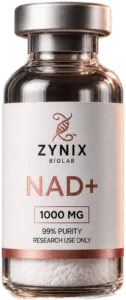
Dosage Chart
Once-daily subcutaneous injection for the 1000 mg vial, with titration over the first two weeks. [4]
| Phase | Daily dose | Units (U-100) | Volume |
|---|---|---|---|
| Week 1 | 50 mg | 15 u | 0.15 mL |
| Week 2 | 75 mg | 23 u | 0.23 mL |
| Weeks 3+ | 100 mg | 30 u | 0.30 mL |
The Week 2 dose rounds to 23 u from a calculated 22.5 u at the 333.3 mg/mL working concentration. Separately, published human pilot studies have used intravenous dosing not derived from this vial protocol: 500 mg administered intravenously for four consecutive days in a tolerability pilot, [2] and 750 mg intravenously over 6 hours in a research pilot examining metabolomic changes. [3] These IV contexts are not compatible with the SC vial concentration above and are not a subcutaneous dosing recommendation.
Reconstitution
1000 mg vial, mixed to a working concentration before drawing a dose.
Add 3.0 mL of bacteriostatic water to the 1000 mg vial to yield a final concentration of 333.3 mg/mL. At this concentration, 1 unit on a U-100 insulin syringe equals 0.01 mL, or 3.33 mg of NAD+. [4]
Store the lyophilized vial at −20 °C. Once reconstituted, refrigerate at 2–8 °C, protected from light, for up to 14 days. [4]
How It Works
NAD+ (nicotinamide adenine dinucleotide) is a coenzyme found in every cell, used in redox reactions central to energy metabolism, DNA repair, and cellular signaling. It is not a peptide, but a dinucleotide derivative of nicotinamide. [3]
In a retrospective tolerability pilot study, two groups each received 500 mg of either NAD+ or nicotinamide riboside (NR) administered intravenously for four consecutive days. The NAD+ arm reported moderate-to-severe gastrointestinal symptoms, increased heart rate, and chest pressure, with longer average infusion times (97 minutes); the NR arm reported only minor tingling and mild cramping, with shorter average infusion times (37 minutes). Neither arm showed significant changes in ALT, AST, hsCRP, BUN/creatinine, or TSH. In that same cohort, the NR arm showed a significant reduction in HbA1c, while the NAD+ arm showed a reduction in HDL cholesterol. [2]
A 2026 critical review of intravenous longevity therapy found transient reductions in oxidative biomarkers and modest improvements in fatigue syndromes with IV NAD+ and related compounds, but noted that few studies incorporate validated biomarkers of aging, and concluded that IV longevity therapy should be regarded as experimental until rigorous randomized controlled trials demonstrate efficacy and safety. [1] Claims around fatigue, cognition, mood, substance use disorder, longevity, and general cellular health are prevalent in wellness marketing for NAD+, though the evidence quality for those claims remains limited, and this page makes no such claim. [3]
NAD+ is not an FDA-approved therapy category for any indication. Compounded NAD+ preparations may be legally used in certain circumstances, but the FDA states they are not FDA-approved and are not reviewed by the FDA for safety, effectiveness, or quality before marketing. [3] This section describes what the cited literature reports; it is not a claim of safety or effectiveness for human use, and it is not an anti-aging or skin-benefit claim.
References
[1] Intravenous Longevity Therapy: A Critical Review of Evidence, Mechanisms, and Clinical Utility · PMID 41915584
[2] Intravenous Infusion of NAD+ Versus Nicotinamide Riboside: A Retrospective Tolerability Pilot Study · PMID 41704678
[3] NAD+ overview · PeptideDosages
[4] NAD+ 1000 mg vial dosage protocol · PeptideDosages