
Dosage Chart
Injectable protocol for the 50 mg vial, 5 days/week, subcutaneous. [5]
| Phase | Daily dose | Units (U-100) | Volume |
|---|---|---|---|
| Weeks 1–4 | 1.0 mg | 6 u | 0.06 mL |
| Weeks 5–8 | 1.5 mg | 9 u | 0.09 mL |
| Weeks 9–12+ | 2.0 mg | 12 u | 0.12 mL |
Schedule shown is the 5-days/week standard protocol. An alternative 3-times-weekly schedule uses a continuous 2.0 mg (12 units) dose throughout the cycle. [5] Standard injectable protocols typically run 12 weeks with the titration above. [5]
Reconstitution
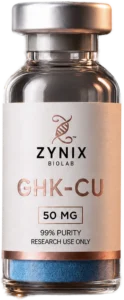
50 mg vial, mixed to a working concentration before drawing a dose.
Draw 3.0 mL of sterile bacteriostatic water and add it slowly down the vial wall to minimize foaming. Reconstituting the 50 mg vial to a final volume of 3.0 mL yields 16.67 mg/mL. Avoid vigorous shaking, which may denature the peptide. [5]
Follow the vial's own documentation for temperature, moisture, and light protection before reconstitution. [5] After reconstitution, stability depends on concentration, pH, diluent, sterility, container, preservatives, and temperature; minimize unnecessary light and moisture exposure, and avoid repeated freeze-thaw cycles. [5] The sources reviewed for this page do not specify a definitive shelf-life duration for reconstituted GHK-Cu: treat any fixed "use within X days" figure as unverified until it is sourced, and see the full reconstitution guide for handling detail. Document the preparation date, concentration, storage temperature, and disposal date for each vial. [5]
How It Works
GHK-Cu is a copper-binding tripeptide complex formed from GHK, a tripeptide made from glycine, histidine, and lysine, and copper ions (molecular formula C14H24CuN6O4, molecular weight 403.92 g/mol). [4]
Published clinical evidence for GHK-Cu is concentrated in topical use. A study of diabetic neuropathic ulcers reported that a topical GHK-Cu gel achieved 98.5% ulcer closure versus 60.8% with vehicle control. [4] Twelve-week topical skin-aging studies in 71 and 41 women reported improvements in skin density, thickness, elasticity, humidity, and wrinkle appearance. [4] A therapeutic hydrogel for diabetic wound repair incorporating a GHK-Cu component has been reported to drive hydrogen-peroxide-to-oxygen conversion, which prevents peroxide overload and alleviates oxidative injury in that formulation. [2]
Evidence for injectable or systemic use is much thinner. A 2026 review lists GHK-Cu among regenerative peptides with growing evidence in chronic pain management, while noting clinical evidence remains limited. [1] A separate review examining GHK-Cu as an emerging peptide supplement found that human clinical evidence for musculoskeletal recovery "remains unsubstantiated by current human trials," despite promising animal-model results. [3] The FDA has flagged compounded injectable GHK-Cu as a safety concern due to limited human safety data, aggregation risk, and peptide impurities, and there is no FDA-approved prescribing label for GHK-Cu as a drug treatment. Long-term safety data remain unavailable for systemic or injectable use. [4] This section describes what the cited literature reports; it is not a claim of safety or effectiveness for human use, and it does not imply the injectable route carries the same evidence base as the topical studies cited above.
References
[1] Peptides in Regenerative Medicine · A comprehensive review of clinical applications in tissue repair and chronic pain management, PMID 42635865
[2] Tea Exosome-Integrated Self-Oxygenating Cascade Hydrogel for Diabetic Wound Healing · PMID 42586657
[3] Peptide Supplements and Their Therapeutic Applications in Sports Medicine · PMID 42578445
[4] GHK-Cu overview · PeptideDosages
[5] GHK-Cu 50 mg vial dosage protocol · PeptideDosages